
Introduction
As organisations grow, the systems that once supported daily operations can begin to feel stretched. Manual workarounds become more common, reporting takes longer than expected, and teams rely on separate tools that do not always connect. Once manageable processes can start to slow the business down.
It is often at this stage that ERP software enters the conversation. The decision, however, is rarely straightforward. It goes beyond adopting a new system and involves rethinking how the business operates across finance, operations, and reporting. When approached without clarity, it can introduce unnecessary complexity. When aligned with real needs, it can bring greater structure, visibility, and control.
Many small and medium-sized enterprises face similar questions. Is this the right time to implement ERP, or can existing systems still support current demands? What level of functionality is genuinely required? How important are local compliance requirements, and how should different providers be assessed in practical terms when selecting ERP software?
Taking the time to work through these considerations carefully can make a meaningful difference. A clearer understanding of where the organisation stands today often leads to more confident, well-grounded decisions about what comes next.
Key Takeaways
- ERP decisions should be driven by real operational gaps, not assumptions about growth or industry trends.
- Clear definition of functional scope helps prevent overcomplication, keeping implementation focused and manageable from the start.
- Local requirements such as GST compliance, multi-currency handling, and regulatory alignment are critical in the Singapore context.
- Evaluating both the system and the implementation partner is essential, as outcomes depend heavily on how the solution is delivered and supported.
- The true value of ERP software emerges when the cost of disconnected systems begins to outweigh the investment in integration.
Part 1: Is ERP the Right Choice for Your Business?
One of the costliest mistakes a Singapore SME can make is adopting ERP too early, or for the wrong reasons.
ERP software is often seen as a natural next step as a business grows. In practice, its value comes from integration. Finance, inventory, purchasing, sales, HR, and operations are brought together within a single system, drawing from a shared source of data. That level of structure only delivers real benefit when processes are complex enough to require it. Without that need, ERP software can introduce more friction than clarity.
A more practical starting point is to look at where your current setup is beginning to strain.
Are teams relying on separate systems that do not connect with one another, such as spreadsheets for inventory, a standalone accounting platform, and manual order tracking? That kind of fragmentation is often an early signal that integration is needed.
Does your team spend time each month reconciling data across systems, re-entering figures, updating stock manually, or cross-checking reports that do not align? The effort may seem manageable at first, but it accumulates over time, increasing both workload and the likelihood of errors.
Is visibility becoming an issue at the management level? Delayed financial reporting, unclear stock positions, or difficulty tracking margins across product lines can indicate that information is no longer flowing reliably.
Growth often brings these issues into sharper focus. Expanding product lines, opening new locations, or taking on contracts that require stronger reporting and audit trails can quickly expose the limits of disconnected systems.
That said, ERP is not always the right move. Smaller teams with straightforward operations can often work more effectively with simpler tools. A well-managed accounting platform or basic inventory system may remain more practical, cost-efficient, and easier to maintain at that stage.
The real indicator is not size alone, but pressure. When the cost of operating across disconnected systems begins to show in staff time, errors, delayed decisions, or missed opportunities, the case for ERP becomes much clearer.

Part 2: Essential ERP Functions
ERP systems vary widely in scope, and not every module carries the same importance for every Singapore SME. Before evaluating specific solutions, it helps to be clear on what your business actually needs.
A practical starting point is to focus on the areas where inefficiencies are already affecting performance. For many businesses, this begins with financial management. Core functions such as the general ledger, accounts payable and receivable, bank reconciliation, GST compliance, and multi-currency handling form the foundation. Given how common cross-border transactions are, the ability to manage multiple currencies accurately is often essential rather than optional.
This is where ERP software begins to show its value by bringing these core processes into a single, consistent system.
From there, the scope should reflect how your business operates on a daily basis.
For distribution and wholesale businesses, inventory management is central. Visibility across multiple warehouses, along with purchase and sales order processing and accurate tracking of goods movement, quickly becomes necessary. Regional operations often introduce additional complexity, including multi-currency transactions and inter-company transfers.
Manufacturing businesses typically require further capabilities such as work orders, bills of materials, production scheduling, and material requirements planning. These functions support tighter control over both costs and timelines.
Service-based businesses tend to rely more on project costing, time tracking, milestone billing, and resource allocation. Without these, it becomes difficult to maintain a clear view of project profitability.
Businesses with a retail component often need integration with point-of-sale systems, supported by accurate, real-time stock updates across both front-end and back-end operations.
One common mistake at this stage is trying to implement everything at once. Expanding the scope too early often leads to longer implementation timelines, higher costs, and slower adoption by teams adjusting to a new system.
A more practical approach is to prioritise. Identify what needs to be in place from day one, what can follow once the system is stable, and what remains a longer-term consideration. For many Singapore SMEs, a core combination of financial management, procurement, inventory, and sales order processing is enough to address the most immediate gaps without overcomplicating the rollout.
With the right scope in place, ERP software becomes far more effective, supporting growth without introducing unnecessary complexity.
Part 3: What Should Singapore Businesses Look for in an ERP Solution?
Many ERP systems appear similar at first glance. The differences become more apparent when you consider how well they support the realities of operating in Singapore.
Choosing the right ERP software involves looking beyond features and assessing how the system performs in a local business environment.
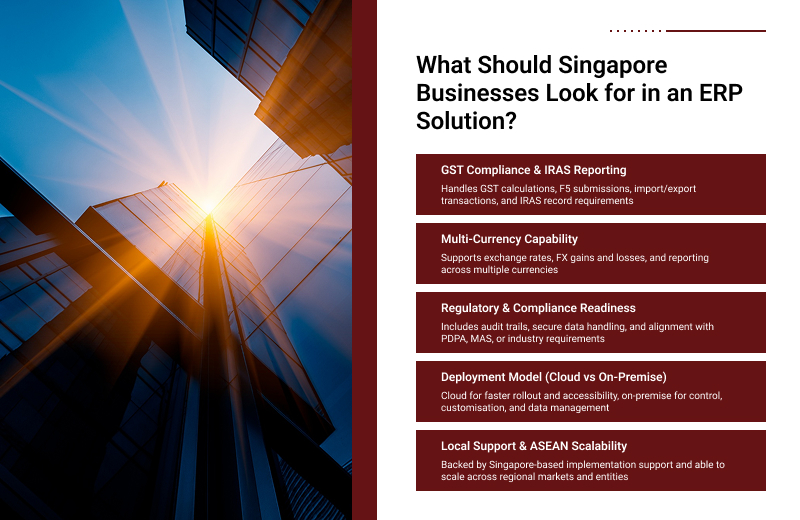
GST compliance and IRAS reporting
GST handling goes beyond basic configuration. Your system needs to support day-to-day transactions accurately while meeting reporting requirements. This includes partial exemption calculations, reverse charge scenarios, and the handling of import and export transactions. The ability to generate compliant GST F5 returns is essential, alongside proper record retention in line with IRAS requirements.
It is also worth understanding how the ERP software manages less common scenarios, such as blocked input tax or adjustments across reporting periods.
Multi-currency as a core function
Multi-currency transactions are a standard part of business for many Singapore companies. This should be treated as a core capability, not an optional add-on.
Look for automatic exchange rate updates, clear tracking of realised and unrealised foreign exchange gains or losses, and consistent reporting across both functional and presentation currencies. Without these, financial data can quickly become unreliable.
Regulatory and compliance readiness
Compliance requirements differ across industries, but most businesses will need a reliable audit trail and secure data handling. Depending on your sector, this may include alignment with MAS expectations, PDPA requirements, or industry-specific reporting standards.
What matters is not just the presence of these features, but how well the ERP software aligns with local expectations rather than relying on generic global configurations.
Cloud or on-premise deployment
Both deployment models remain relevant. The decision depends more on operational needs than on trends.
Cloud-based systems typically reduce upfront costs, simplify updates, and allow easier remote access, making them suitable for businesses that want quicker deployment and lower internal IT demands. On-premise or private cloud setups offer greater control, which may be important for businesses with specific data residency requirements, higher transaction volumes, or more complex customisation needs.
For companies operating across ASEAN, control over how data is stored and managed across jurisdictions can also influence this decision.
Regional scalability across ASEAN
Expanding beyond Singapore introduces additional complexity. Tax frameworks, currencies, and reporting requirements differ across markets such as Malaysia, Indonesia, Thailand, and the Philippines.
A system that works well locally may encounter limitations when new entities are introduced. It is worth assessing whether the ERP software can support multi-entity consolidation and adapt to different regulatory environments without significant rework.
Local support and implementation capability
The system itself is only part of the equation. Implementation and ongoing support play a significant role in determining long-term success.
A provider with local experience is better positioned to configure the system correctly, anticipate common challenges, and provide timely support. Without that, even capable ERP software can become difficult to manage. A proven track record in Singapore, supported by a local team, often makes a meaningful difference during both implementation and day-to-day use.
Part 4: Comparing ERP Software Providers in Singapore
The ERP landscape in Singapore includes global platforms, regional solutions, and locally developed systems. On the surface, many appear similar. In practice, the differences often come down to how well they fit your business and how effectively they are implemented.
A structured approach helps bring clarity to the evaluation, especially when assessing different ERP software providers in Singapore.
Start with your own criteria, not the vendor’s
Product demonstrations can be persuasive, but they should not define your requirements. A more reliable approach is to establish what matters before engaging any vendor.
This usually includes your core functional needs, the systems that must integrate from the outset, your working budget for both software and implementation, your expected timeline, and the level of internal support available during rollout. With these in place, each ERP software option can be assessed on a consistent basis rather than being influenced by individual presentations.
Separate the software from the implementation partner
In Singapore, many ERP systems are delivered through authorised partners rather than directly by the software vendor. This makes the choice of partner just as important as the product itself.
Two businesses can implement the same system and achieve very different outcomes depending on how it is configured and supported. Evaluating both elements together provides a clearer picture of what to expect.
It helps to ask practical questions about the partner’s local experience, recent projects, familiarity with your industry, typical implementation timelines, and what is included in their quoted scope. Post-implementation support should also be clearly understood from the outset.
Look beyond licence fees
Software pricing is often the most visible figure, but not necessarily the most significant. Implementation work, such as configuration, data migration, user training, and go-live support, can form a substantial portion of the overall investment.
Ongoing costs should also be considered, including support agreements, additional user licences, and system updates. Looking at the total cost over several years provides a more accurate basis for comparison across different ERP software solutions.
Consider long-term viability
ERP is a long-term commitment. Systems that are not actively maintained or updated can quickly fall behind changing regulatory and operational requirements.
Understanding how frequently updates are released, how local regulatory changes are handled, and whether enhancements are built into the core product or require additional customisation can help avoid complications later on.
Test real-world scenarios
Product demonstrations often focus on ideal use cases. A more reliable way to assess suitability is to walk through your own processes.
Using actual transaction flows, reporting requirements, and integration points allows you to see how the system performs in conditions that reflect your business. This approach tends to reveal gaps and limitations early, when they are still easier to address.
Part 5: When Is Sage 300 Appropriate?
Sage 300 sits within the mid-market ERP category and has been widely used across Singapore and the broader Asia-Pacific region for many years. It is not designed for every type of business, but for certain operational profiles, it can be a strong fit.
As with any ERP software, its suitability depends on how closely it aligns with the way your business runs.
Where Sage 300 Performs Well
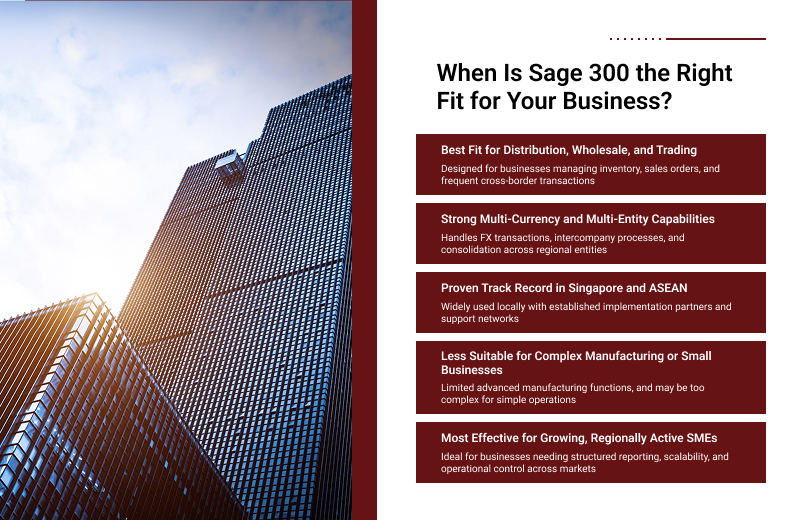
Sage 300 is particularly suited to businesses in distribution, wholesale, and trading, where multi-currency transactions and inventory control are part of daily operations. Its multi-currency capabilities are built into the system rather than added on, which makes a difference when managing frequent cross-border transactions across ASEAN.
It also supports businesses operating across multiple entities. Intercompany transactions and financial consolidation are handled in a way that is practical for Singapore-based companies managing subsidiaries in markets such as Malaysia or Indonesia.
Its established presence in Singapore is another advantage. There is a mature network of implementation partners and local support, which can make a noticeable difference during both setup and ongoing use. Familiarity with local business practices often leads to smoother implementation and better alignment with existing workflows.
Where It May Be Less Suitable
The Sage 300 software is not primarily designed for manufacturing environments with complex requirements. Businesses that rely on detailed production scheduling, shop floor control, or advanced material planning may find its capabilities limited and may need to consider alternatives that are more manufacturing-focused.
For smaller businesses with straightforward operations and lower transaction volumes, it may also feel more complex than necessary. In such cases, implementation effort and cost may outweigh the benefits.
Businesses looking for a fully cloud-native system with flexible, usage-based pricing may find it less aligned with newer SaaS-first platforms, although cloud-hosted options are available.
A Practical Approach to Assessing Suitability
The key consideration is operational need. If your business requires structured multi-entity reporting, reliable multi-currency handling, and a system with a proven track record across regional operations, Sage 300 is worth evaluating.
If your requirements are more straightforward, a simpler ERP software solution with lower total cost and faster deployment may be the more practical choice.
Part 6: Incorporating PSG Funding into Your Decision-Making Process
The Productivity Solutions Grant (PSG), administered by Enterprise Singapore, can offset a meaningful portion of implementation costs. For eligible SMEs, it provides co-funding of up to 50 per cent on pre-approved IT solutions, capped at S$30,000 per enterprise. While this can ease the financial commitment, it applies only under specific conditions.
When evaluating ERP software, it helps to understand early on how PSG may or may not apply to your chosen solution.
Eligibility requirements
To qualify, your business must be registered and operating in Singapore, with at least 30 per cent local shareholding held by Singapore citizens or permanent residents. It must also fall within the defined size limits, either by turnover or employee count, and the solution must be deployed locally.
Timing is a critical factor. Any payment made before approval, including deposits, will disqualify the application. The grant does not apply retrospectively, so this needs to be planned for from the outset.
PSG coverage for ERP
PSG supports only solutions listed on the GoBusiness portal. Not every system qualifies, so it is important to confirm early whether the ERP software under consideration appears on the approved list.
Where applicable, the grant can cover part of both software and implementation costs, including configuration, setup, and related services, within the overall funding cap.
Integrating PSG into the decision-making process
PSG is most effective when it supports a decision that already makes commercial sense. It can reduce upfront costs and bring forward implementation plans, but it should not be the primary factor when comparing different ERP solutions.
A system that does not align with your operations will create higher costs over time, regardless of any initial subsidy. When the right fit has already been identified, PSG simply lowers the barrier to moving ahead with greater confidence.
Planning around the application process
Approval timelines typically take several weeks, so this needs to be factored into your implementation schedule. Without proper planning, this stage can delay the overall project timeline.
Vendors familiar with the PSG requirements often assist with the application process, including preparing quotations in the required format. Clarifying this early can help avoid unnecessary delays.
Accounting for these factors ensures that your chosen ERP software can be implemented smoothly, without disruption to your overall timeline.

Part 7: Reaching a Final Decision
At this stage, the focus shifts from exploring options to narrowing them down with clarity.
Start by grounding the decision in actual business needs. The case for ERP should be tied to specific operational gaps, whether in time lost reconciling data, limited visibility, or constraints on growth. Without that clarity, it becomes difficult to justify the investment or define what success should look like.
From there, ensure the scope is well defined. The system should reflect what your business needs today, while leaving room for additional functions to be introduced later. Expanding too much too early often leads to unnecessary complexity during implementation.
Local requirements should already be accounted for. GST handling, multi-currency transactions, and regulatory considerations are essential in the Singapore context. It is equally important to assess whether the vendor has real experience delivering projects locally, rather than simply offering the product.
Product fit is best validated through real use cases. Observing how ERP software handles your actual processes provides a far more reliable view than generic demonstrations. Speaking with existing users in similar industries can also reveal practical insights that are not immediately visible during sales discussions.
Cost should be considered over time, not just at the point of purchase. Implementation, support, and ongoing system maintenance often make up a significant portion of the total investment. Looking at these together allows for a more balanced comparison.
If PSG funding is applicable, it can be factored into your timeline and financial planning. Its role is to support a decision that already makes sense, rather than to determine it.
Finally, the implementation partner plays a central role in the outcome. Their experience, approach, and level of support will shape how smoothly the system is introduced and adopted. Choosing the right partner often makes as much difference as selecting the right system itself.
Conclusion
Approached carefully, the process tends to follow a clear pattern. Businesses that arrive at the right outcome take time to understand their requirements, test solutions against real operational needs, and work with partners who are familiar with the local landscape. The result is not just a functioning system, but one that aligns with how the business actually runs.
This is where ERP software becomes most effective, when it supports existing processes while enabling the business to operate with greater clarity and consistency.
Acsolv Consult is Singapore’s only award-winning Sage 300 specialist and a PSG pre-approved vendor. Many of our clients see a measurable reduction in manual accounting work after implementation, often freeing up 20 to 30 hours each month.
Selecting an ERP system goes beyond choosing software. It influences how your business operates, how information moves across teams, and how decisions are made over time. The impact is rarely immediate, but it builds steadily, shaping efficiency, visibility, and control.
If you have worked through this framework and are ready to move forward, request an ERP assessment to determine whether Sage 300 fits your operations and whether you qualify for PSG funding.